Showing posts with label Morocco. Show all posts

Friday, 3 June 2022

Morocco Revisited

Morocco is mesmerising, the closest country where the culture is intriguingly different. So tempting for those craving a change after almost two years of isolation - barely 3 1/2 hours by plane and 1-hour time change…


Where to go? Castleblanca, Rabat, Fez, Essaouira, Tangiers…The latter though charming is still pretty nippy at this time of the year, so how about Marrakech with its date palms and cactus, souks and bazaars and the incomparable Jemaa el-Fnaa square in the heart of the medina, a magnet for both Moroccans and visitors flocking to be fed, watered and entertained. Drink freshly squeezed juices (no alcohol) and watch hypnotic musicians like swirling dervishes, swirling jugglers, snake charmers… Have a pic taken with a monkey on your shoulder or with colourful tea sellers who make more money from having photos taken than by selling tea. Donkeys weave in and out through the narrow lanes of the medina with carts full of oranges.
There are henna artists, soothsayers, a frenzy of merchants selling their wares from sparklers and balloons to little bowls of snails in broth and a selection of false teeth should you need them... At night, local cooks and chefs set up long tables on the side of the square selling steaming bowls of harira with fresh dates, grilled fish, tagines, every conceivable type of offal. A wonderfully convivial experience and the food overall is above average.
But my absolute favourite is mechoi, the meltingly tender milk-fed lamb, cooked slowly for hours in underground clay ovens until the succulent meat is virtually falling off the bones. You’ll find it from noon to about 4pm along Mechoi Alley – a little lane on the east side of the square. Look out for Haj Mustapha, he was the last Hassan’s (Kings) private chef who now owns Chez Lamine and several stalls selling not just mechoi but also goat’s heads, and tangia, a lamb stew in a clay pot, traditionally cooked in the ashes of the fire that heats the water for the hammans. I even tasted karaein – cow’s hooves with chickpeas. Been there, done that – don’t need to do it again…

The medieval city of Marrakech with its ten kilometres of ochre coloured adobe, ramparts and seven awe-inspiring ornamental gates has many landmarks. The minarat of the Koutoubia Mosque dominates the city. Like most mosques in Morocco, it’s closed to non-muslims but is still a mightily impressive building.

Marrakech was the destination for merchants, camel traders and caravans who had crossed the desert and the snow-capped Atlas mountains with their wares. It’s steeped in history…and if you only eat in one restaurant, it has to be Al Fassia, the women’s restaurant in Gueliz and how about Al Baraka, a petrol station on Rue de Fez, about 15 minutes outside Marrakech – inexpensive but delicious food.
The highlight of my trip was a morning food tour with Plan-It Morocco. And even though I’ve been to Marrakech many times, I discovered many new places with Bilal, my deeply knowledgeable guide. We started at the Kasbah, originally a posh neighbourhood close to the royal palace, now a commercial area with lots of little shops, bakeries and stalls. First stop - a little stall selling sfeng, the famous deep-fried breakfast doughnuts eaten plain or sometimes with an egg in the centre and a sprinkling of crunchy sea salt and cumin. Actually these doughnuts are served all day but are sprinkled with sugar in the afternoon. We wandered through the narrow alleys and watched women making a variety of different breads. Every neighbourhood has an underground wood-fired oven which doubles up as a community bakery. Women bake traditional round flat breads in their homes, lay them on a cloth covered board to rise. It’s bought through the streets to be baked in the oven when the baker has finished cooking his daily loaves. In Morocco, there are more than seven types of Moroccan bread – all delicious. 
Stalls were piled high with beautiful fresh vegetables and fruit, I watched a beautiful old lady in a patterned black and white kaftan removing the fibres from long cardoon stalks. First with a knife and then a coarse nylon brush. I bought a bag back to Tarabel Riad and asked the cook to prepare them for my dinner in a delicious tagine of cardoons and potatoes.

In the Jewish quarter, we sat at a little tin table to have another traditional Moroccan breakfast - Bissara, a thick bean soup sprinkled with cumin and chilli pepper, drizzled with olive oil. It comes with a basket of bread for dipping.

I could write several blogposts on the bread alone.

On past the once famous Sugar Market to watch the warka makers working at the speed of knots, dabbing the dough onto hot saucepan lids over boiling water to make the paper-thin sheets of warka used for chicken and pigeon pastilla and a myriad of other pastries.

Next stop, Belkabir, the most famous pastry shop in the medina with 40 or more sticky sugar laden pastries from horns de gazelle to briwat (triangle shaped pastries filled with marzipan, deep-fried and dipped in honey).
We continued to meander through the souks, with its stalls piled high with everything from Moroccan slippers, fake bags and ‘designer’ clothes, metal work, hand carved wooden spoons and boards, brassy trinkets, hand blown glass…and finally into a little secret corner called Talaa, to Chez Rashid, a favourite haunt of the locals. I loved their sardine ‘meat balls’ with cumin and coriander – so delicious with chopped raw onion or with tomato sauce.

We continued to walk through the souk – then back to the beautiful Tarabel Riad where Kahil picked oranges from the trees in the inner courtyard to make some freshly squeezed orange juice to quench my thirst…Sure where would you get it but in lovely Morocco.


Friday, 24 April 2020

Marrakesh

Seeing as we're all stuck at home and in need of a little colour and excitement, I thought I'd revisit my trip to Morocco last year, which I didn't get around to sharing on the blog at the time...

Exotic, crazy, colourful Marrakesh, so many intriguing cultural experiences but for the cook it’s a brave new world of tagines, cous cous, pastilla, meschoi, briouts, tangia, rfusa…


At first, the experience is virtually overwhelming. The souks and medina cover an area of approximately 19 km and are not for the fainthearted. Acres of stalls selling everything you can imagine and much that you can’t. I armed myself with a map and the phone number of the manger of the riad where I was staying so they could come and rescue me if and when I got hopelessly lost.
Before you venture into the Medina, sit down with a glass of frothy mint tea and a plate of Moroccan pastries and plan your adventure. I only had five days but I was determined to make the most of every moment.


I’d chosen to stay at a beautiful chic riad owned by Jasper Conran, L'Hotel Marrakech, with just five elegant bedrooms surrounding an inner courtyard garden with orange and banana trees, a date palm and a trickling fountain in the centre even a 10 metre lap pool for those who might like a refreshing dip even in winter. The food was delicious – breakfast, lunch and dinner – Bouchra is the cook (dada) here. The elegant dining room has tall metal windows, huge mirrors and portraits of Indian maharajah. Billie Holiday crooned and the candles flickered as I enjoyed my first dinner at a low round table by the fireside. Three little Moroccan salads, zaalouk (aubergine), taktouta (red and yellow pepper), cooked carrot and cumin and then a superb lamb tagine with artichoke hearts, fennel and cooked to melting tenderness so all the flavours melded together. The dessert was layers of flaky warka with pastry cream and a chocolate caramel sauce. We’d hit the jackpot…

Breakfast was another little feast, four different Moroccan breads and lacy beghrir, the tender Moroccan pancakes. I was determined to learn how to make at least these light lacy pancakes. I cheekily knocked on the kitchen door; Bouchra welcomed me into her kitchen and over the next few days showed me how to make a whole range of breads. Many, ingenious variations on the well-known Moroccan flat bread – msemen. 

Some were cooked on the griddle others, shallow fried then drizzled with honey and sprinkled with coconut. Some were savoury to enjoy with eggs or b'sara (buttara), the thick lentil and bean soup often eaten for breakfast. Others were light, flaky and slathered with honey butter. Then there are all the tagines which take their name from the earthenware pot with the conical lid in which they are served and if you are lucky also cooked. These can be vegetarian or made from seafood, chicken, beef, lamb or rabbit with seasonal fresh vegetables and fresh or dried fruit, olives and maybe nuts.


Tagine royale with dates or prunes, almonds and apricots, is one of the best loved of all. But there’s also chicken with preserved lemon and green olives or with caramelised onion and raisins or with caramelised onion and tomato. I ate superb versions of these at Al Fassia on 55 Boulevard Mohamed Zerktouni in the Ville Nouvelle, owned by the Marraskhi sisters and almost entirely run by women. The food is superb but you must book ahead. I managed to do it on the internet from Ireland and confirmed when I arrived in Marrakesh. Don’t miss the pastilla with pigeon and the mezze made up of fifteen Moroccan salads, I had both lunch and dinner, sounds beyond greedy but I simply couldn’t taste as many dishes are I wanted in one sitting.
Cardoons were in season during my visit and they too make a wonderful addition to a tagine.


Close to L'Hotel Marrakech on Derb Sidi L’ahcen St there were lots of little shops and stalls piled high with freshly harvested vegetables and fruit, others offered an enormous variety of spices, olives of every hue and preserved lemons, an essential flavouring in so many Moroccan dishes.
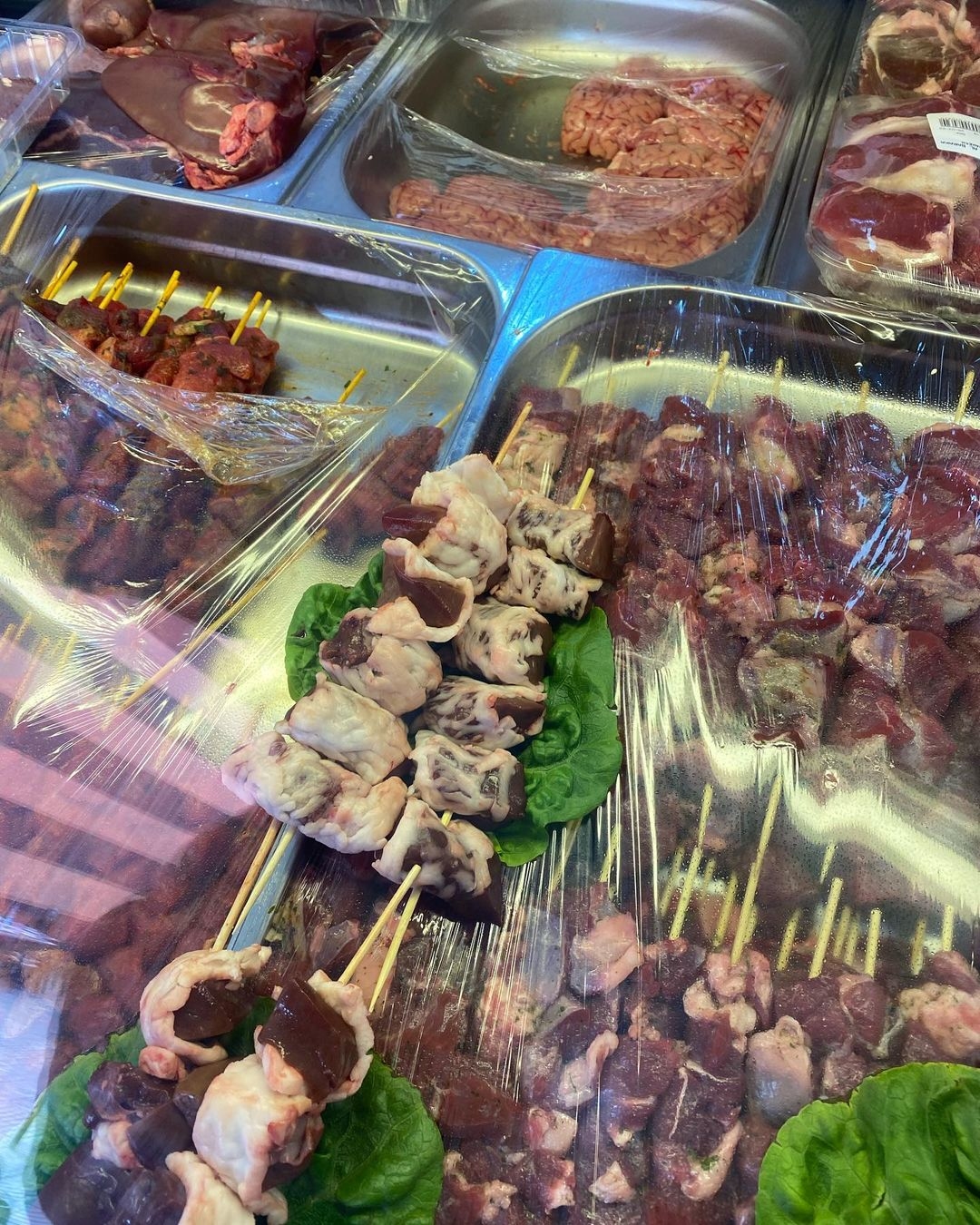
Lots of little butcher shops too. Everything was very fresh– there doesn’t seem to be a tradition of hanging meat and every scrap of the animal is sold and used, heads, feet and all the offal and entrails. Street food of every hue, apart from msemen, round or square, flat bread, cooked on a griddle and served with butter and honey. One stall just sold goats feet to add to tangia, a stew cooked in an earthenware pot in the underground wood-fired ovens that heat the water for the famous hamman (baths).


The flavour and texture of the slow cooked meat that emerges from the earthenware pots is rich and delicious and continues a long tradition.
You’ll find a little cluster of cafes that serve tangia and meschoi, meltingly delicious slow roasted lamb falling off the bones served with cumin and salt on Meschoi alley on the east side of Djemaa El Fna just around the corner from the olive and pickled lemon souk.
For harira and bsara head for Djemaa El Fna, Marrakesh’s central square, a crazy open theatre. There are snake charmers, henna tattoo artists, colourful water sellers in fringed hats that make more money from having photos taken than they do from selling water. 


At night the square ramps up several notches, over 100 chefs arrive with their grills, utensils and set up their stalls. Musicians tune their instruments and the fun begins in earnest. 

Everywhere vendors are trying to entice you to try their specialities. The adventurous shouldn’t miss the snails and sheep’s head and other miscellaneous parts. Slide onto a bench beside a stall and enjoy every second of the spectacle and the food – unlikely to be a gastronomic experience but the atmosphere is unforgettable.