Showing posts with label Examiner column. Show all posts

Thursday, 16 March 2017

Why We Should Eat Less Meat

Former President of Ireland, Mary Robinson, really put the ‘cat among the pigeons’ recently when she called on people from developed nations to consider eating “less meat or no meat at all”, due to the toll its production takes on the environment.  Her address to 1,300 current and future young world leaders from 196 nations at the One Young World Summit in Ottawa caused quite a stir around the world but particularly here in Ireland.


Mary Robinson's address at One Young Word (Image credit: One Young World)
The remarks drew a tirade of condemnation from several farming organisations and rural TDs, who seemed to assume this statement was aimed directly at them.
Irish beef farmers are understandably particularly sensitive having been directly affected by the fall in the value of sterling as a result of Brexit.
Because of the quantity of methane and slurry produced by animals, livestock rearing is seen as a major contribution to greenhouse gases. However, here in Ireland our dairy and beef animals are primarily, though not completely, grass fed so consequently they produce much less gas than grain fed animals reared in intensive feed lot systems. A fact that needs to be repeated loud and clear… We are not comparing like with like, it’s simply not the same thing.


The cows at Ballymaloe Cookery School
Ireland can grow grass like virtually nowhere else in the world so surely it makes sense for our farmers to produce good beef for export to areas that are not so favoured by nature. The quality of Irish beef is highly esteemed. It was served recently at the Breeder’s Cup in California on the invitation of the organisers. Good Food Ireland was partnered by Dawn Meats and Bord Bia to showcase Irish beef at this super high profile event considered to be the ‘richest two days in sport’
However, back to Mary Robinson, we must be careful not to ‘shoot the messenger’. There’s no doubt that many people nowadays eat far more meat than is beneficial for their health.
Much of that meat is produced in extremely intensive units which raise both animal welfare and chemical input concerns.


Our farm shop full of fresh veg from our organic farm
Although I eat mostly plants, copious amounts of vegetables, fresh herbs and wild foods, I’m certainly not a vegetarian. I love good meat but increasingly find myself eating less meat but better quality totally free range and organic. I am happy to pay more to those who are rearing animals and poultry in a more extensive way.
We urgently need a system where food producers can be identified and rewarded for producing a superior product. We also need to create a new paradigm where the contribution of organic and chemical free farmers to the environment is acknowledged in tax breaks.
So Mary Robinson would like us to consider a vegetarian or vegan lifestyle for the sake of the planet and future generations. Scientists have confirmed that a widespread change in our eating habits would cut food related emissions by two thirds. However many are reluctant to forego meat altogether.


Nonetheless, we can’t ignore the validity of the arguments so why not seek out an organic chicken. It will cost you €18-€22 as opposed to €3.50 – Ouch… and that’s if you can even find one.  That is the real price of rearing and feeding a chicken with organic GM free feed for approximately three times the length of the bargain chicken without antibiotics, hormones, growth promoters or anti-depressants. Organic always means free range but free range certainly does not mean organic. Free range is a very ‘elastic term’, so ask some questions…
So back to the days when chicken was a ‘once a week’ or even once a month treat and every single scrap was used, liver for pâté, giblets, carcass and feet for a fine pot of stock soup or broth – there’s nothing more nourishing or restorative particularly if you are feeling slightly poorly – it’s not called ‘Jewish penicillin’ for nothing.
Pork, too needs careful sourcing to find organic or chemical free.  Close to us here in East Cork, we have Woodside Farm where Martin and Noreen Conroy and their family work hard to provide us with beautiful heritage breed Saddleback pork and bacon, only problem they simply can’t keep up with demand – catch up with them in County Cork at Midleton and Douglas on Saturday, Mahon on Thursday and Wilton Farmers Markets on Tuesday. 
In Curraghchase in County Limerick, Caroline Rigney and her husband Joe also produce exceptional pork at Rigney's Farm.
Mary’s right in many ways. We have to change; we simply cannot go on with ‘business as usual’. For the sake of our children, great grandchildren and the planet, we all need to commit to the Paris Agreement. Each and every one of us needs to think about our carbon footprint – we can each make a vital difference.

This is one of the reasons that we have chosen to focus on "Responsibility" as our Symposium theme at LitFest this year. We have gathered a tremendous range of journalists, chefs and food producers to discuss all aspects of the topic from 19th-21st May, see my last post for a round up of some of the exciting speakers we have in store for you. Visit the LitFest website to book.

Monday, 2 February 2015

Spring has Sprung - the new Skye Gyngell restaurant

Spring, Skye Gyngell’s restaurant was one of the most anticipated restaurant openings in London for several years. 

Skye, whose super fresh food at Petersham Nurseries in Richmond thrilled and excited real food lovers from all over the world, had not been actively involved in the restaurant scene for over two years. In that time she and her team were actively seeking out exciting premises in central London. 

After much toing and froing they eventually chose part of the New Wing at Somerset House, where the Inland Revenue had its office for 158 years. 


The new space could not be much further in style from the original charming greenhouse at Petersham Nurseries where mismatched tables, crockery and cutlery on the clay floor created a sophisticated up-cycled boho chic look. 


Here in Spring, Skye shows her elegant ultra-chic side by transforming what by all accounts was a dull and dreary room into a haven of sophistication with a Zen-like feel.  

The walls are pastel with tiny handmade porcelain flowers by Valeria Nascimento fluttering across the walls. There’s a marble counter at one end from which drinks and house cordials are dispensed. The cutlery is by English cutler David Mellor and the leather chairs are by Mario Bellini.


The chandeliers which resemble bunches of frosted balloons cast a soft flattering glow. Not everyone loves the atmosphere or the eccentric staff uniform designed by Trager Delaney of Egg. I personally found them playful and quirky... and why not?


The food was totally delicious, quintessentially Skye even though she wasn’t in the kitchen herself that night. Beautifully fresh ingredients shine through with the minimum of interference. 

The stunning desserts at are the creations of Sarah Johnson and her team. Sarah interned here at the Ballymaloe Cookery School for a while and honed her considerable skills at Chez Panisse in Berkeley  as well as Pizzaiolo in Oakland.


The wine list would also blow you out of the water impressing even the most seasoned wine buffs. Deeply knowledgeable sommelier Frank Embleton has been given both the brief and budget to create one of the most fascinating and well-chosen lists in London to compliment Skye’s food. 

Put Spring on your London list. Open seven days for lunch and dinner.

Tuesday, 13 May 2014

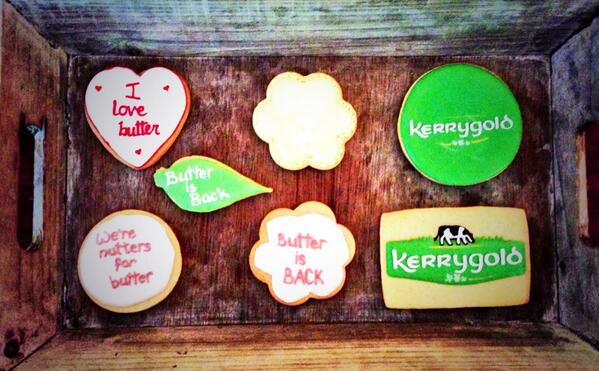
Butter is Back!

When I did my Simply Delicious TV series in the 1980s and '90s,  I used to get regular letters berating me for using butter and cream in my recipes. Had I no sense of responsibility? Didn't I realise that saturated fats were bad for us? Why wasn't I recommending low-fat alternatives?

You can imagine my reply!


I simply could not believe that butter, a totally natural product, made from the milk of grass-fed cows, could be less healthy than an artificial product made up of ten or more ingredients, some of them produced in a lab rather than originating in nature.

I was regularly referred to as the Butter Queen of Ireland, and once overheared someone say: "There's that Darina Allen 'wan' - she's a hoor for the butter!"

Despite the barrage of abuse I got, I never faltered. And surprise, surprise, it now appears, all those years later, that my gut feeling was right.


It's interesting how the tide has turned...

In October last year, Dr Aseem Malhotra, an eminent cardiologist at Croydon University Hospital, argued, in a widely reported piece in the British Medical Journal, that it was time to bust the myth of the role of saturated fat in heart disease. 

From his analysis of independent research he concluded that there is no argument to back up the theory that saturated fats from non-processed foods are detrimental to our health. He maintains that saturated fats have been ‘demonised’ ever since a landmark study in the 1970’s concluded that there was a correlation between the incidence of coronary heart disease and total cholesterol. An entire food industry has evolved and profited from this low fat mantra for almost four decades. For more on this see my November 16th article in the Irish Examiner.


These findings caused quite a sensation. And it wasn't just Dr Malhotra and his colleagues who have come to this conclusion. A recent study from Cambridge University and the Harvard School of Public Health published in the Annals of Internal Medicine reported that they found no link, repeat, no link between consumption of saturated fats and heart attacks or other cardiovascular problems. The 22-year-long Harvard University study of 80,000 female nurses, has confirmed Malhotra's findings: the total amount of fat in the diet, whether high or low, isn't really linked with disease. What really matters is the type of fat in the diet. In the US a recent University of California, Los Angeles study indicated that 75% of acute heart patients do not have ‘high cholesterol’. 


Embedded image permalink

I have spoken to many doctors, dieticians and heath professionals who are presently in a state of confusion, having been preaching the benefits of a low fat diet for years, they are now not sure what advice they should be giving.


So it’s clear that it's time to rethink the received wisdom on what "good" and "bad" fats are - which is exactly what two of the most respected writers and broadcasters on food issues: Joanna Blythman and Ella McSweeney, will be doing in conversation with John McKenna at this year's Kerrygold LitFest. The Good/ Bad Fats: The Big Debate 6.30-8pm on Saturday 17th in the Grainstore, Ballymaloe House   


I simply can't wait. This promises to be one of the most interesting, important and ground-breaking sessions at LitFest this year. If you're interested in health for professional or personal reasons this is not to be missed.


We're also absolutely delighted  to be joined by The Butter Vikings, an inspirational couple from Sweden, who are the chosen suppliers of  handmade "virgin" butter for Rene Redzepi's legendary Noma restaurant. I met the Butter Vikings and Rene at the MAD Food symposium in Copenhagen and invited them to take part in LitFest - the response of both was an enthusiastic "yes please!" 

And whilst we're on the subject of butter, the other great news is that Kerrygold have agreed to become our festival sponsors- how about that for a marriage made in heaven?


JR - a butter devotee and Ballymaloe pastry chef -  in his Kerrygold bow tie at the LitFest launch in Dublin last week.


Thursday, 14 June 2012

A blog at last, well almost!

I've been wanting to write a blog for years but simply couldn't seem to get started, a bit ridiculous considering I write a weekly column in the Weekend section in the Examiner. But it's even more bizarre than that because I never learned to type, all my books were written in my scrawly longhand and then typed by my unfortunate secretaries, corrected, retyped and on and on and on......

Consequently, I had a major block about any kind of technology but as I travelled particularly in the US I felt increasingly embarrassed to have to admit that I was a technophobe.

The ultimate proposterous situation occurred when I was scheduled to appear on Martha Stewart Kitchen, live. Her research team sent a list of questions to Sharon at the Cookery School, she forwarded them to my hotel who delivered the email to my bedroom. When I arrived back I tried to telephone the TV station, I could only get an answering machine, by this stage Sharon in Ireland had gone home for the day so I was going to have to wait for her come in next morning to dictate my answers for her to send to Martha Stewart, problem was it would be too late, I'd already be in the studio. Even I could see that this situation was beyond ridiculous - this was the turning point!

On my return I asked for an iPad for my birthday and the rest is history. It's been and still is a slow and painful process. At first a short email would take me at least 20 mins to do and then I would somehow manage to loose it and be totally traumatised by the experience. I felt like throwing my hat at it several times but then a pal suggested I type everything in Notes initially so I couldn't lose it - another big break through . I'm still very slow and still reach for the pen more often than my iPad but I'm working on it and this, my very first post marks another milestone for me.