Friday, 3 February 2017

GIY HQ

It's spring again and the 12-week course is in full swing - 13 nationalities this time. Dark and dreary when they arrived, but now the evenings are getting longer and the birds are singing and snowdrops, crocus and tiny daffodils are bursting in flower. For the past few weeks I've spent many cosy evenings by the fire flicking through seed catalogues, choosing varieties of vegetables, fruit and herbs to plant during the coming season. I can't wait for the ground to warm up enough to get some seeds planted. Our 12-Week Certificate students are equally impatient to get started. On the first day when they arrived, we showed them how to sow a seed and then gave them a lettuce seedling to plant into the ground so we've whetted their appetite to think about growing some of their own food. 

Every now and then one comes across a natural leader, a person with an impossible vision who has the tenacity and charisma to make their vision a reality against all the odds. Michael Kelly, founder of GIY Ireland is certainly such a person and it can be a tiny incident that sparks an idea – this whole movement which supports the growing efforts of 150,000 people and 6,000 food communities both in Ireland and the UK, all started with garlic.


Michael Kelly (Image Credit Ilovecooking.ie)
Michael was busily doing the food shopping one dark evening, not his favourite task, he picked up a bulb of garlic – 50 cents, he was outraged to discover that it had come ‘all the way from China’.
It set him thinking surely to goodness we could grow garlic in this country.
Out of this outrage was born, what is now one of the most important social grass roots movements in the country: GIY – Grow It Yourself. 

Michael shared his discovery with some of his friends; they decided to arrange a meeting to ‘test the waters’. Did others feel the same? Was there any interest in this topic? Was there a hunger for knowledge? Over 100 people turned up to the initial meeting in the Waterford Library one September evening in 2008, standing room only – obviously there was an appetite to learn what for some was a ‘forgotten skill’ for others a longed for skill to learn how to sow a seed and grow even a little of their own food.
Michael had inadvertently stumbled upon a longing, among a significant number of people to discover the magic of sowing a seed and having the satisfaction of watching it grow into something they could eat and feed to their families in the secure knowledge that it was nourishing, wholesome and free of chemicals. Since that small beginning in 2008, Michael and his messianic team many of whom have soldered by his side voluntarily since the very beginning has travelled up and down the country starting branches, organised eight
GIY Gathering Conferences in Waterford, supported over 6,000 local champions, inspired and encouraged and continued to dream.
Michael was invited to deliver a DO lecture in Wales in 2012, during that event he became even more aware that the movement needed a headquarters, a centre where people could visit, see edible gardens bursting with vegetables, herbs and fruit, learn how to grow, eat and gather together to share the fresh seasonal food from the garden.
On the ferry boat back, he scribbled a ‘note to self’ on his pad – ‘must do, GIY HQ’ and stepped off the boat at Rosslare with an enhanced mission.
He shared his vision, it resonated with many people.
A vision is one thing, but raising €1.4 million to realise that vision is quite another – a massive fund raising campaign ensued over 4 years and on 8th October, GIY HQ was opened to a joyous reception from hundreds of supporters, well-wishers and local businesses and the passionate GIY team. It’s rare enough to find a work force so totally committed to an ideal as the group of twenty six super charged individuals who are overjoyed to be part of this project.


Michael outside Grow HQ (Image Credit - Waterford in your Pocket)

Michael thanked the myriad of people who had helped and supported his vision along the way but reserved extra special mention for Waterford County Council who had unanimously voted to donate the 3 acre site at Farronshoneen on Dunmore Road opposite the University Waterford Hospital and the Solas Centre to GIY.


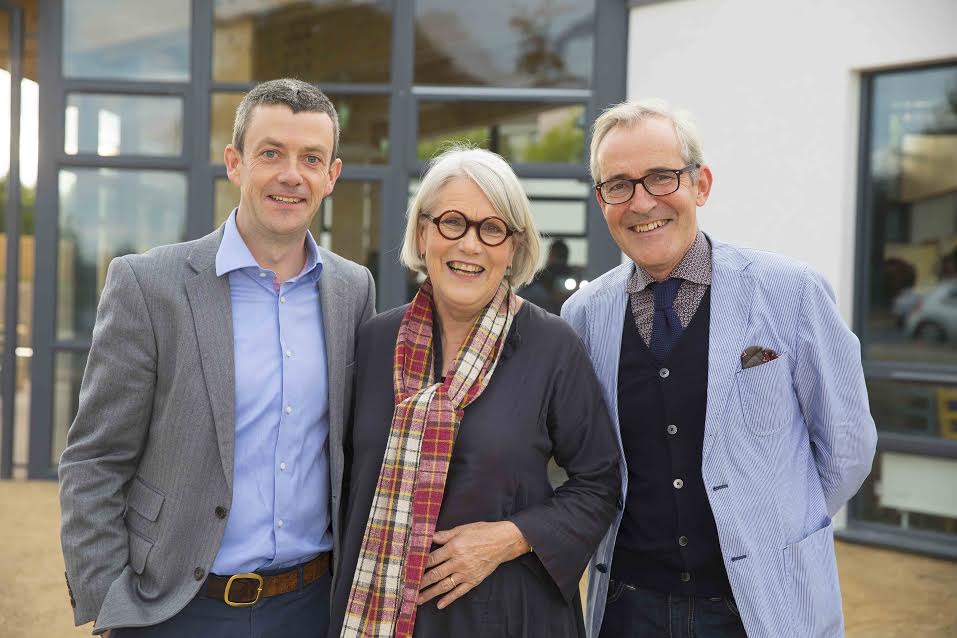
Myself and Rory with Michael at the opening. 
The sustainable building on was designed by Solearth Architecture and encompasses class room, cafĂ©, shop and cooking school –and now the work really begins. Check out the Grow HQ website... and come and see him at this year's Litfest in May, at Ballymaloe.


Monday, 30 January 2017

In Praise of Real Bread


A freshly baked loaf of Ballymaloe Cookery School sourdough bread

I’m totally in despair at the quality of our squishy sliced bread and deeply concerned about the effects on our health and waistline. Many, not least the Bakers Association of Ireland, would disagree with me and I certainly hope they are right. I myself can’t seem to find out what exactly is in the bread, an enormously important staple for many people. Flour, yeast, salt, water, so far so good but what else to speed up the process and produce a loaf at this price?
The term ‘processing aids’ seems to cover a multitude of enzymes, improvers and preservatives which don’t all have to be put on the labels as ‘processing aids’ are exempt, so much for transparency….
The good news however is that in pockets here and there around the country, artisan bakeries are bubbling up in response to the craving for real bread.
In Cork City, Declan Ryan came out of retirement in 1999 and started to bake real bread in his garage which morphed into a large bakery employing eight full time bakers in Mayfield.


Declan Ryan of Arbutus Bread with some of his beautiful loaves

Declan sells his Arbutus Bread at Farmers Markets and specialist shops as far away as Dublin. He, like many others who were inspired by him can scarcely keep up with demand.


ABC Bread (Image: Tom's Foodie Blog)
Also in the Cork area – ABC Breads in the English Market and Pavel Piatrousky from Pana Bread in Midleton have their loyal devotees.
Seagull Bakery

Another of the pioneers, Sarah Richards who established Seagull Bakery in Tramore in 2013 was also inspired by Declan Ryan.
In January 2015, Real Bread Ireland was started by a small group of craft bakers as a support network for those who wished to learn how to make real bread either professional or at home.

And we sell our own homemade breads here at the Ballymaloe Cookery School Farm Shop.


Our Ballymaloe Cookery School sour dough bread

So what exactly is Real Bread? Well, in its purest form, it is bread without the use of processing aids or any other artificial additives. Real Bread is made without improvers, dough conditioners, preservatives, chemical leavening (baking powder or bicarbonate of soda) any other artificial additives or the use of pre-mixed ingredients. 
That pretty much rules out 90% of the bread on our supermarket shelves.  And buyer beware, much of the bread that’s sold as ‘sourdough’ contains yeast which is not at all the same as a natural sourdough.


Making bread at the Ballymaloe Cookery School

The good news is there’s a quiet revolution going on at grass roots level, small craft bakers are popping up here and there around the country, the use of organic and heirloom flours is increasing significantly, the general public is becoming aware that something is amiss as the number of people with a gluten intolerance continues to sky rocket.
A growing body of disquieting research is emerging on the effects of the random use of glyphosate on wheat both as a herbicide and before harvesting on our health and the environment.
Ellie Kisyombe from Malawi kneading dough at Ballymaloe Cookery School

Making a long and slowly fermented sourdough is certainly a mission’ but a loaf of soda bread, the traditional breads of our country is literally mixed in minutes. A few scones will be out of the oven in 10 or 12 minutes while a crusty loaf will be ready in 35 or 40. 
Few things we do, give so much pleasure and nourishment for so little effort. A truly nourishing, wholesome national loaf would do much to enhance the health of the nation. This was done in Norway in the 1970’s with remarkable results.
Check out the Real Bread website. 
Many bakers including the Ballymaloe Cookery School will share some of their sourdough starter free with keen beginners. (Please telephone ahead - 021 4646785).


Wednesday, 25 January 2017

Slow Food - Direct Provision Scheme

We are delighted to welcome Ellie Kisyombe, an immigrant and asylum seeker from Malawi, to share her experience of the Direct Provision Scheme and how it impacts on food and education. 


At Ballymaloe Cookery School, Shanagarry, East Cork.
Wednesday, February 1st.

The talk will start at 7pm. Join us for a cup of coffee and some of Ellie's homemade treats from 6.30pm.  


Image: http://www.tn2magazine.ie/cooking-up-a-storm/


This is part of our series of East Cork Slow Food events.

Spread the word to family and friends, we'd love to see you...

Slow Food Members €6.00/Non Slow Food Members €8.00

For more information call us at 021 4646785 or slowfoodeastcork@gmail.com


For more on Ellie see here. 

Tuesday, 24 January 2017

Veronica Steele - matriarch of Irish cheesemakers

We were all deeply saddened by the recent passing of one of our Irish food heroes, Veronica Steele, the matriarch of the Irish cheesemakers. So I want to write a little tribute to an extraordinary woman who has touched so many of our lives and whose legacy will continue to remind us of this, bright, beautiful, charismatic, self-deprecating character who unwittingly started the artisan food movement in Ireland.
Image: Farmer's Journal
I can’t begin to improve on this wonderfully description of how it all began in Veronica’s own words on the Milleens website.
“The origin of the initial concept is fading in the mists of time. Hunger and shame. There was nothing to eat: nothing interesting. The old shop in Castletownbere with its saucepans and shovels and Goulding’s Manures clock wagging away the time, and smoked hams hanging from hooks in the ceiling and huge truckles of cheddar on the wooden counter with their mouldy bandages the crumbs of the cheese strewn around, scrumptious, tempting, melt-in-the-mouth crumbs which you could nibble at as you queued to be served, with your message list. And then she would cut a fine big chunk, golden or white and what I missed the most is the way it crumbled. So they closed it and gutted it and extended it and re-opened it. Enter the trolley. Spotless, sterile, pre-packed portions sweating in their plastic. Tidy piles. Electronic scales. Keep moving. Don’t block the aisles. No idle chatter. Big brother is watching you. Don’t ask for credit. Oh boy!
And then one day in a different shop that jolly French pair of geriatrics asking for the local cheese and being given Calvita.

And then we bought a farm and a cow. Her name was Brisket and she only had one horn. She lost the other one gadding down a hill. tail-waving, full of the joys of Spring. Her brakes must have failed. We had to put Stockholm tar on the hole right through the hot Summer. And all the milk she had. At least three gallons a day. Wonder of wonders and what to do with it all. And then remembering those marvellous cheddars. So for two years I made cheddars. They were never as good as the ones in Castletownbere had been but they were infinitely better than the sweaty vac-packed bits.
Veronica in the early days of Milleens - Image - Good Food Ireland
Very little control at first, but each failed batch spurred me on to achieve, I was hooked. Once I had four little cheddars on a sunny windowsill outside, airing themselves and Prince, the dog, stole them and buried them in the garden. They were nasty and sour and over salted anyway. Those were the days.

So one day Norman said, ‘Why don't you try making a soft cheese for a change’. So I did. It was a quare hawk alright. Wild, weird, and wonderful. Never to be repeated. You can never step twice into the same stream. Now while this was all going on we had a mighty vegetable garden full of fresh spinach and courgette’s and french beans, and little peas, and all the sorts of things you couldn’t buy in a shop for love or money. And we would sell the superfluity to a friend who was a chef in a restaurant and took great pains with her ingredients. She would badger the fishermen for the pick of their catch and come on a Monday morning with her sacks to root through our treasure house of a garden for the freshest and the bestest. Now I was no mean cook myself and would have ready each Monday for her batches of yogurt, plain and choc-nut, quiches, game pies (Made with hare and cream – beautiful), pork pies, all adorned with pastry leaves and rosettes as light and delicious as you can imagine, and fish pies, and, my speciality, gateau St Honore.


So there was this soft cheese beginning to run. We wrapped up about twelve ounces of it and away it went with the vegetables and the pies and all the other good things to Sneem and the Blue Bull restaurant where it made its debut. Not just any old debut, because, as luck would have it, guess who was having dinner there that very same night? Attracted no doubt by Annie’s growing reputation and being a pal of the manager’s, Declan Ryan of the Arbutus Lodge Hotel in Cork had ventured forth to sample the delights of Sneem and the greatest delight of them all just happened to be our humble cheese . The first, the one and only, Irish Farmhouse Cheese. At last, the real thing after so long. Rumour has it that there was a full eclipse of the Sun and earth tremors when the first Milleens was presented on an Irish cheese board.
The product had now been tested and launched. Its performance, post launch left nothing to be desired. The very next night Ms Myrtle Allen, accompanied no doubt by other family members, of Ballymaloe House, similarly engaged in testing the waters of Sneem, polished off the last sliver of the wonderful new cheese and was impressed by its greatness. And then began the second phase of research and development. Improvement.
For eight years, this was written in 1986, now we have devoted our energies to the continued improvement and development of Milleens cheese, and show no intention of stopping. The changes in the product have been gradual and subtle and in line with increases in production which are always kept in line with the growth in demand.
Image: Good Food Ireland

As the product developed so too has the packaging which is both simple and highly sophisticated. As Milleens must travel by both post and refrigerated transport a package had to be strong enough for the rigors of the postal system yet with sufficient ventilation to avail of the benefits of refrigeration where available. Our strong wooden boxes met these requirements. It was also thought necessary that the box serve as an attractive display for the cheese ensuring that the name Milleens was displayed prominently, and differentiating it from other products. It has been most successful in this area too and customers invariably display the cheese in the box. Very clever altogether. The boxes are made and stenciled here in our workshop by ourselves and members of the staff. Apart from growing and felling the timber all the phases of their manufacture take place at Milleens. They compare most favorably in price with any box on the market.
When Milleens was first made we knew enough about cheese making to write a slim volume, vast quantities of knowledge have since been ingested form all available sources form Scientific American to the Journals of Dairy Science and pamphlets from New Zealand on Bacteriophage. Grist to the mill. Making Milleens is no longer a slap-happy matter but has become a carefully controlled scientific process. thermometers have replaced elbows. Acidometers play their part now. But most of all milk quality is carefully monitored. Starters have long been recognized to have a most important influence on cheese flavor and quality, and are as well looked after as the crown jewels and to better effect.”
Oh, to be able to write so evocatively – I too remember when Annie Goulding at the Blue Bull in Sneem gave me a taste of her ‘friend over the hills’ cheese in the early 1980’s. At the time, as Veronica said we were a nation of Calvita eaters and one can but imagine the excitement when we discovered this feisty flavourful cheese that tasted of that place and tasted of Ireland. A new cheese was born – the beginning of a new era that has totally changed the image of Irish food both at home and abroad and has us bursting with pride.
Veronica had a vision for Ireland – farmhouse cheesemakers in parishes all over the country making cheese from their rich milk of their pasture fed cows. As she continued to experiment herself, she generously shared her knowledge, and encouraged so many others to get started. Jeffa Gill of Durrus, Giana Ferguson of Gubbeen, Mary Burns of Ardrahan and a whole host of others lovingly acknowledge Veronica’s influence. We visited Milleens many times and brought students and dignatories from all over the world to meet Veronica and her equally charismatic husband Norman. Always an open door, always a warm welcome. Nowadays their son Quinlan, the next generation, continues to make Milleens and build on his parents work.
And here at Ballymaloe House and Ballymaloe Cookery School we still serve Milleens cheese proudly and give thanks for the life of Veronica, the matriarch of all the Irish farmhouse cheese makers.
Veromica receiving the inaugral Lifetime Achievement Award from the Irish Farmhouse Cheesemakers Association at Ballymaloe House in 2015 - Image - Good Food Ireland

Monday, 9 January 2017

LitFest 2017 - Tickets on Sale Today

So here we are, 2017! Happy New Year!

Can you believe it, this year marks our fifth LitFest and we are delighted to announce that the festival is now officially called the Ballymaloe Food and Drinks Literacy Festival. 

It's still LitFest, but the ‘lit’ in the title now refers more generally to food and drinks literacy. There will be a little less about books and a lot more about the impact of our food choices on our health, our environment, our wellbeing, our economy. 

It runs Friday 19th to Sunday 21st May and tickets go on sale today.

The Grainstore will once again serve as an exciting auditorium becoming the symposium centre and the beating heart of the festival. Over the weekend, the symposium at Litfest 2017 will stage a thought-provoking and inspiring series of short talks and presentations from both the published and not yet published. Gathering an interesting and dynamic pool of professionals, writers, experts and authorities from at home and around the world, the festival will focus minds and thoughts on the question of responsibility – our responsibility as cooks and eaters.

The LitFest 2017 symposium is designed to spark imagination and generate discussion, prompting attendees to recognise their individual role as a crucial link in the food chain. Every time we cook something we have a responsibility – a responsibility to the people we are cooking for and the people who produced the food we are cooking. We have a responsibility to the environment and to the planet, and each choice, every action has its own impact. This crucial conversation, led by some of the most thought-provoking and dynamic writers and thinkers about food of our generation, will be passionate, factual and inspiring and is a must visit for all food-lovers to this year’s festival.

This year's speakers and guest chefs include:
  • Brian McGinn, director of the Emmy-winning Netflix documentary series Chef’s Table
  • Slovenian chef Ana Roš of Hiša Franko in Kobarid
  • Jacob Kennedy, chef patron of Italian restaurants Bocca di Lupo in Soho and Vico 
  • And making a welcome return visit to LitFest 2017 is Claudia Roden, beloved Middle Eastern cookbook writer and cultural anthropologist
  • This year's pop up restaurants will be run by British chef, caterer, and cookery writer Margot Henderson and Dublin-born Robin Gill whose string of innovative and exciting London restaurants – The Dairy, The Manor and Paradise Garage – has made him one of the hottest chefs in London

Tickets go on sale today, so be sure to head on over to the website right now, as many sell out within hours. The full schedule of participants and events  www.litfest.ie


Friday, 9 December 2016

A Taste of Turkish Street Foods

I wanted to share with you some of my favourite street foods... and drinks from my trip to Turkey, where eating on the street is a feast for all the senses.


  1.     Simit – chewy sesame crusted ‘Turkish bagels’ brushed with pekmez, grape molasses, available from street carts all over the city. Enjoy them anytime, anywhere with Kahue, Turkish coffee or Cay, black tea, in curved glasses.

2.    Kestane Kebab– roasted chestnuts

3.    In summer don’t miss Misir freshly boiled or grilled sweet corn.

4.    Baklava– buttery flaky pastries in a myriad of shapes filled with nuts, dripping with syrup or honey – seek out Karaköy GĂĽllĂĽoÄźlu bakery and Develi Baklava in EminönĂĽ – for a flat breakfast version with pistachio.


5.    Lokma– a traditional Ottoman Palace dessert, little dough balls, fried until crisp, then soaked in a honey-syrup and occasionally sprinkled with chopped pistachios.

6.    Doner Kebab– I’ve never been quite brave enough to try Doner Kebab until I visited Istanbul, it's made with chicken, lamb or beef sometimes interspersed with vegetables then char-gilled on a vertical spit and served in lavash (bread), sooo good.

7.     Dolma–  vine, cabbage or chard leaves, stuffed with rice and meat, there's also a meat less version made with currants and pine nuts known as Yalance – called imitation or cheats dolma – eat them with yoghurt.

8.    Balik Ekmer– freshly grilled fish sandwiches from the Karaköy EminönĂĽ area close to the Galata bridge.

9.    Midye Dolma– Mussels, still in the shell, stuffed with spicy rice.

10.  Borek–  flakey savoury pastries filled with cheese, meat or vegetables. Sometimes cigar shaped or rolled into to a snake like coil 

11.  Pide–  (pronounced pee – day) long boat shaped pizza like bread stuffed with mince, a variety or meat, vegetables, cheese and egg filling,  cooked in a wood burning oven.

12.  Gösleme– a sort of flat bread pancake rolled up with a variety of savoury fillings, then cooked on a Saç or metal griddle.

13.  Dondurma–   Turkish ice-cream whipped in the Kabraman Maras tradition.


14.  Lahmacun – a pizza-like flat bread with a paper thin crust topped with spicy minced lamb and cooked in a wood oven. Eat it with lots of flat parsley and freshly squeezed lemon juice.

15.  Kokorec – another famous Turkish street food, kokoreç is an old Ottoman dish made of rolled sheep’s intestines roasted on a horizontal spit over a charcoal fire, then chopped and mixed with ripe tomato, dried thyme and red pepper flakes, served with crusty bread.


16.   Icle Kofte– crisp little croquettes with pointy ends stuffed with minced meat, usually lamb, walnuts, spices and red pepper flakes.

17.   Kunefe – made from kadajif, a kind of shredded wheat pastry, tossed in melted butter, filled with melting cheese, soaked in syrup with pistachio nuts sprinkled over the top. It’s cooked in little tin dishes over a charcoal fire – divine.

18.   Lokum – Turkish delight in a myriad of flavours, nothing remotely like the sweet sugary tooth wrenching confection that passes for Turkish delight outside Turkey. Seek out Altan Sekerleme a fourth generation family business in Kuciek – Pazar where they make their own Turkish delight and Akide sekeri. (rock candy)

19.   Kebab or Kebap –  some on skewers but others like little patties, A restaurant in the Kurdish area under the viaduct served buryan, a kind of pilaff, with shredded chicken, currants and some gentle spices in a crispy pastry crust decorated with almonds.

20.   Kaymak – clotted cream, best is made with buffalo milk and eaten with honey. 

21.   Manti – Turkish ravioli, tiny meat or vegetable filled pasta served with a garlic yoghurt sauce and hot paprika butter drizzled over the top just before serving.

22.   Tripe soup, IĹźkembe Çorbasi – a brilliant hangover cure!

23.   Pickles – Tursu are an integral part of Turkish daily eating and drinking. There are pickle carts and shops in every neighbourhood, pickle juice is drunk as a digestif and considered to be a brilliant hangover cure!

24.   Turks have a fantastic selection of dried fruit, nuts and seeds.


Drinks

1.     Raki – the national drink of Turkey, made from distilled grapes, flavoured with aniseed and drunk with ice and water, served in 'meyhanes' with mezze.

2.     Pomegranate juice –  freshly squeezed on virtually every street corner.

3.    Ayran –  a frothy yogurt drink, simply natural yogurt whisked with ice cold water plus a tiny pinch of salt. This was our best simple find of the trip, we have been making Ayran since our return and both grandchildren and students love it.

4.     Boza – a thick drink made from fermented milk with the texture of slightly fizzy apple puree. It is eaten with a sprinkling of cinnamon and  roasted chickpeas on top and is reported to cure the plague.

Thursday, 1 December 2016

Visiting The Golden Triangle - Rajasthan


I’m driving through rural Rajasthan, a world apart from well-known Golden Triangle of Jodpur, Jaipur and Udaipur. The fields are a patchwork of crops: wheat, sesame, mustard grown for both oil and seeds…

 Here and there, bananas and tamarind trees and occasionally a huge banyan tree. Shepherds with long walking sticks, tend their flocks of sheep and goats, now and then a camel cart laden with anything from fodder to huge slabs of sandstone from the local quarries. 


Women in bright saris are working in the fields, pulling weeds or harvesting and occasionally by the roadside carrying broken rocks in tin bowls on their heads, men supervise...


There’s virtually never a time when there aren’t people in sight. Lots of little villages bustling with life, a ramshackle and mesmerising mix of stark new build cement cubes and crumbling traditional houses, often a mixture of both. 


The electricity is a mĂ©lange of wiring that would put the heart 'cross wise' in a health and safety officer, yet it all seems to work. Lots of tiny shops, selling everything and anything. Street carts piled high with fruit and vegetables. Others sitting on the roadside with just a few little chillies, aubergines, maybe a few beans to sell. 


Little hardware shops selling all kinds of pots and pans, grinding stones, coconut graters, coir ropes, handmade brushes, rat traps, tin utensils…  open-fronted shops with dressmakers, cobblers and tailors, sewing on old fashioned treadle machines, barbers and shavers who lather up people’s chins with old fashioned shaving brushes by the roadside. Every service is provided bicycle mending, woodwork, basket making, even ironing with huge heavy metal irons  relegated to museums over here.

In the tin area, craftsmen are turning out huge metal trunks for dowries.  Virtually all the signs are in Hindu, cows nonchalantly ramble through the streets confident that no one will harm them,  the cow is sacred and revered in India. 


In the little villages everywhere the children wave and cheer when they see us ‘take my photo’, ‘take my photo’. I’ve never known an area where people were more welcoming or friendlier, no one asks for rupees or a peno!


Men, sip tea in the Chai shops, katori, bright orange jalabas and samosas are piled high for sale in open air dhaba’s . There are sweetmeat shops, Indians have an incredibly sweet tooth and also love their snacks. So lots of shops sell just bags of crisps, namkeen and lotto tickets.


Hairy, scrawny pigs and chickens snuffle amid the garbage and there are lots of stray dogs. Out in the countryside the bird-life is astonishing, white egrets and mina birds walk along the buffalo’s back picking off ticks. Cow pats dry on walls and rooftops, fuel for the little clay or outdoor stoves over which most people cook their food. A totally holistic and sustainable system. 


Here in rural Rajasthan many women, partially cover their faces with their saris, older men still wear a colourful turban  and sport an impressive moustache. The houses are colour washed, blue, ochre, pink or plain. There are a few jeeps gaily painted, colourful lorries, lots of richly decorated homemade tractors with no cab or cover on the engine (something to do with tax) and of course countless bikes and motorbikes with three and often four people riding on top including a sari clad lady sitting side saddle.


We’re on our way to Ramathra Fort in the Karauli district – it’s a four hour drive from Jaipur airport along a mixture of roads, tiny bursts of motorway an occasional dual carriageway but mostly potholed roads, dirt tracks with numerous ramps. After 4½ hours we turn up a steep stony roadway and at last we are there...... This gives new meaning to the words ‘off the beaten track’. It’s an endurance test to get here but what an oasis…


A 17th century fort still owned  by descendants of the original Maharaja of Karauli who built the structure in the 1700’s and the family have been here for over a 1,000 years. Rajasthan was never conquered by the British. It has now been restored and opened as a heritage hotel by the Thakur Brijendra Raj Pal family with just 6 suites and 6 luxury Rajasthani tents.  There's a 365 degree view over Rajasthan from the 80 ft ramparts. Below us the Kalisil Lake and dam and the forts, organic gardens owned by Brijendra Rajpal who invested the hard earned profits from her carpet business in Jaipur into restoring the fort from an advanced state of dereliction.


The food is delicious here. Virtually everything is produced on the farm or in the local area. They grow and mill the wheat for the chapatti, paratha and poori . The mustard oil is made from mustard grown in their own fields, the yoghurt from the milk of the buffaloes whose manure is used to activate the compost to enrich the soil for the organic gardens.

No swimming pool but an unheated Jacuzzi on one of the turrets with a staggering view of the local countryside, possibly the best in the whole of India. The fort has been restored using traditional building techniques and local craftsmen. We had a memorable boat trip on Kalisil Lake before sunset. It’s on the fly path to Bharapter, a rich feeding ground for ducks, storks, cormorants, kingfishers, sarus, cranes, stilts and herons. The lake was formed over 50 years ago when the Kalisil river was damned for an irrigation scheme that now benefits local farmers in Rawathara and neighbouring villages along the canal. The lake is fed by monsoon rains and when full spreads over 17 km,  all the way to the Holy City of Kailaden.


A walk through the local village, Ramathra was quite simply enchanting, the villagers are so friendly and welcoming and curious. They welcomed us into their houses and invited me to dance with them to celebrate a recent wedding. 


In the local school, the teaches were eager to show us around and one me an impromptu Hindu lesson.

The big bonus for me was the food. It was particularly delicious here and guests can learn how to prepare any of the dishes on the menu. I had two cooking classes with the owner Geetanguli and her shy and brilliant chef.  At Ramathra Fort they make all their own chutneys and pickles and the best lime pickle I have ever eaten. He showed me how to make this fascinating smoked Ramathra chicken curry and raita, home made paneer, several Indian flat breads, paratta  and particular fascinating local bread called Batia.  Ovens are rare in Indian homes, even in the more affluent homes of people so in villages all cooking is done over an open fire on a clay or in more affluent homes in the urban kitchens on gas rings. For over 60% of people in India, the fuel of choice is still dried ‘cow pats’  and despite our understandable initial surprise it doesn’t smell and is totally sustainable. Ramatha Fort is quite a find – particularly for the more adventurous traveller – I long to return…